Which is the better upright vacuum cleaner: Roborock Dyad Pro or Dreame H12 Pro?

In this review, I decided to compare the two best upright wet vacuum cleaners of 2023. At least the first half of it. We are talking about Roborock Dyad Pro And Dreame H12 ProBoth models boast advanced features, high-quality build quality, high efficiency, and the brand's reliability. Therefore, it's not easy to decide which cordless wet/dry vacuum cleaner to choose. So, below, I'll compare the key parameters, as well as the results of my own tests. Based on these results, I'll express my opinion on which wet/dry vacuum cleaner is the better choice. So, let's get started!
Price
First, let's compare the prices of competing wet/dry vacuum cleaners. The Roborock Dyad Pro starts at $280 on AliExpress during sales. The regular price in local stores ranges from $380 to $450.
The lowest price I've found for the Dreame H12 Pro is $350. That's just one listing on AliExpress. Local retailers range from $410 to $500.
We see that the Roborock Dyad Pro is cheaper than its main competitor. However, it's worth noting that the Dreame comes with slightly better accessories. It comes with a proprietary cleaning solution, a spare roller, and a spare HEPA filter. Roborock's only accessory is a HEPA filter. It's not necessarily worth the extra cost, but it's worth considering.
Design
Now let's compare the design of the Roborock Dyad Pro and Dreame H12 Pro. These upright vacuum cleaners operate on the same principle. They have separate tanks for clean and dirty water. Clean water is fed into the cleaning module, which collects debris, scrubs away dirt, and even collects liquids. All the collected dirty water is then sucked into a separate dirty water tank. But there are some key differences.
The first is the cleaning module itself. The Dreame H12 Pro has a single roller that takes up almost the entire width of the module, extending out on both sides close to the edges of the body. However, due to the locking tabs on the sides, there's a small blind spot on both sides, a few millimeters wide. To be precise, according to my tests, this blind spot is no more than 8 mm.
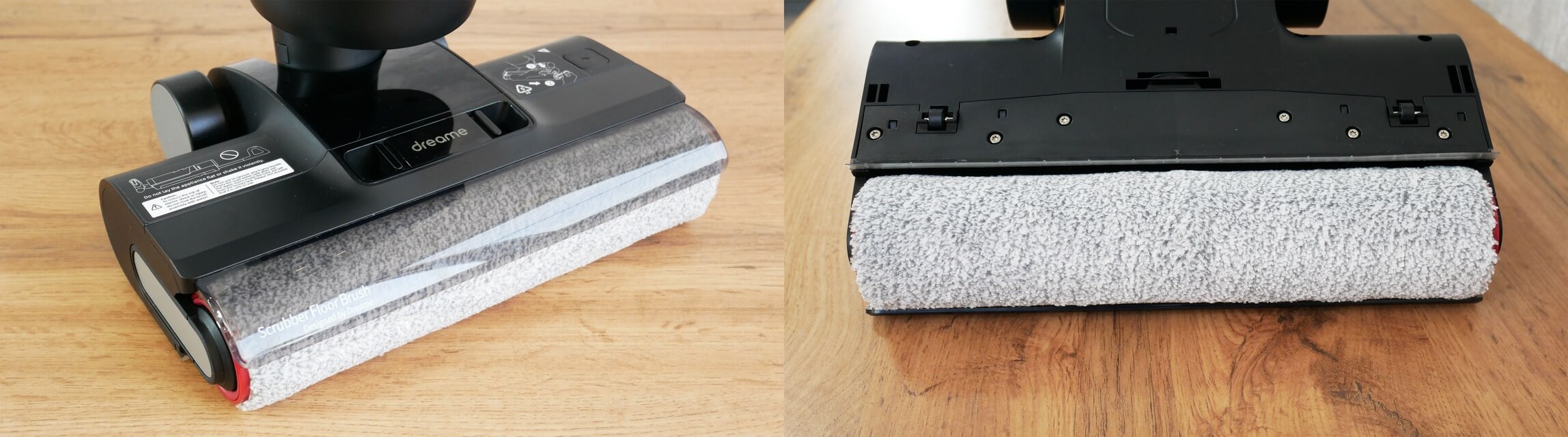
Dreame H12 Pro Cleaning Module
The Roborock Dyad Pro's cleaning module features three rollers: two short ones at the front and one solid one at the back. This design supposedly improves dirt removal. But more importantly, the front two rollers extend directly to the edge of the body on both sides. As a result, the blind spot is completely eliminated, despite the manufacturer's stated 1 mm.
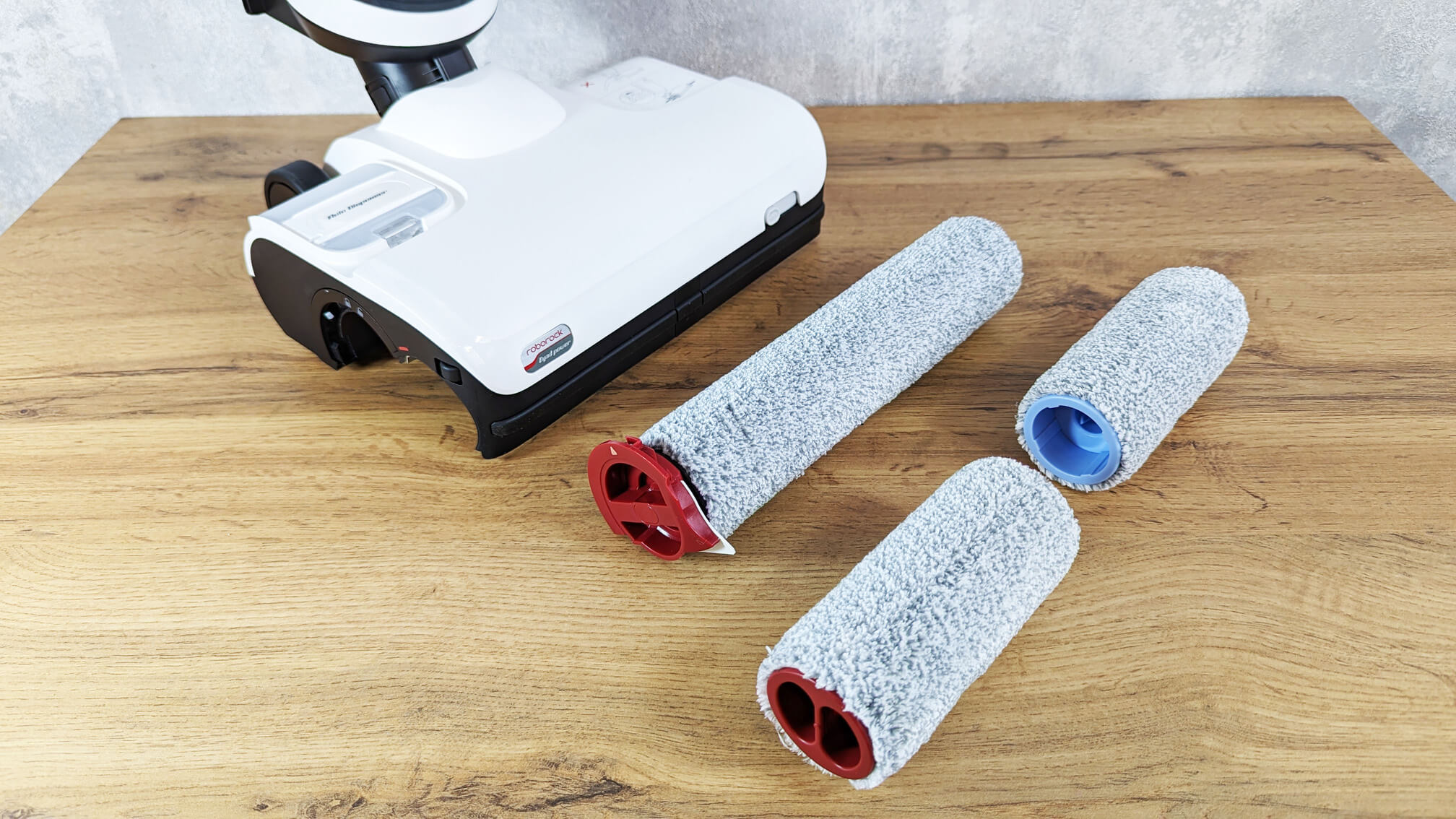
Roborock Dyad Pro Cleaning Module
Additionally, the Roborock's cleaning module is equipped with a detergent cartridge, which automatically dispenses detergent to the rollers and mixes with water. One cartridge is sufficient for 20 tankfuls of clean water. With the Dreame, detergent must be added manually, in the correct ratio.
The clean water tanks of the compared vacuum cleaners have the same capacity, 900 ml, but are different in shape. However, the Dreame's tank is equipped with a water sterilization system, which helps disinfect liquids. I can't confirm the effectiveness of this solution, but it has been implemented.
The dirty water tanks are slightly different. The Dreame's tank capacity is 700 ml, while the Roborock's is 770 ml. But it's much more important to evaluate the filtration system. The Dreame simply has a HEPA filter with a mesh, while the Roborock has a HEPA filter with a mesh and an intricately designed coarse filter. I consider this a slight advantage over its competitors.
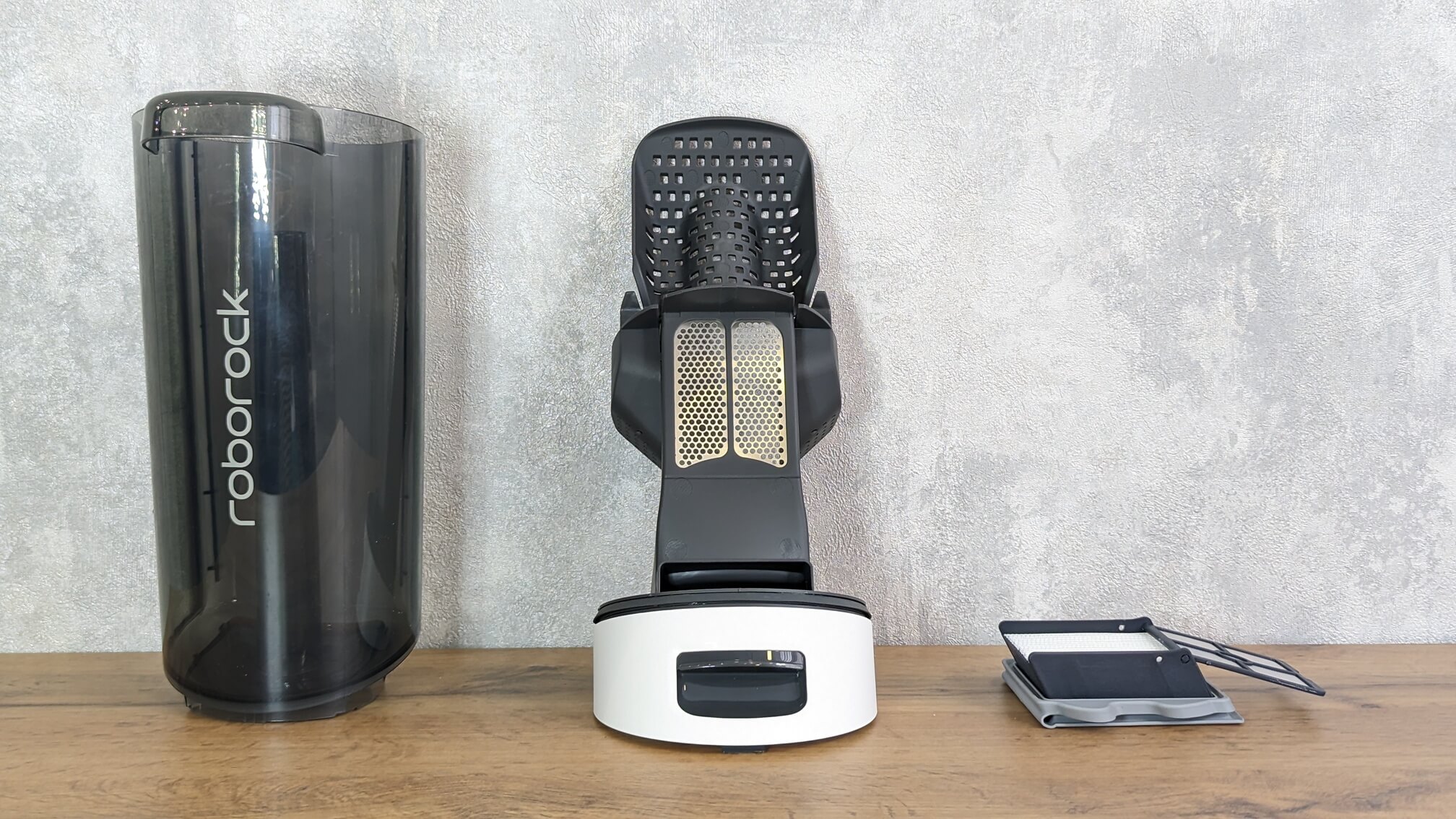
Roborock Dirty Water Tank
Both vacuum cleaners have informative displays, but the Dreame's looks much more sophisticated. It's hardly an advantage, just an observation.
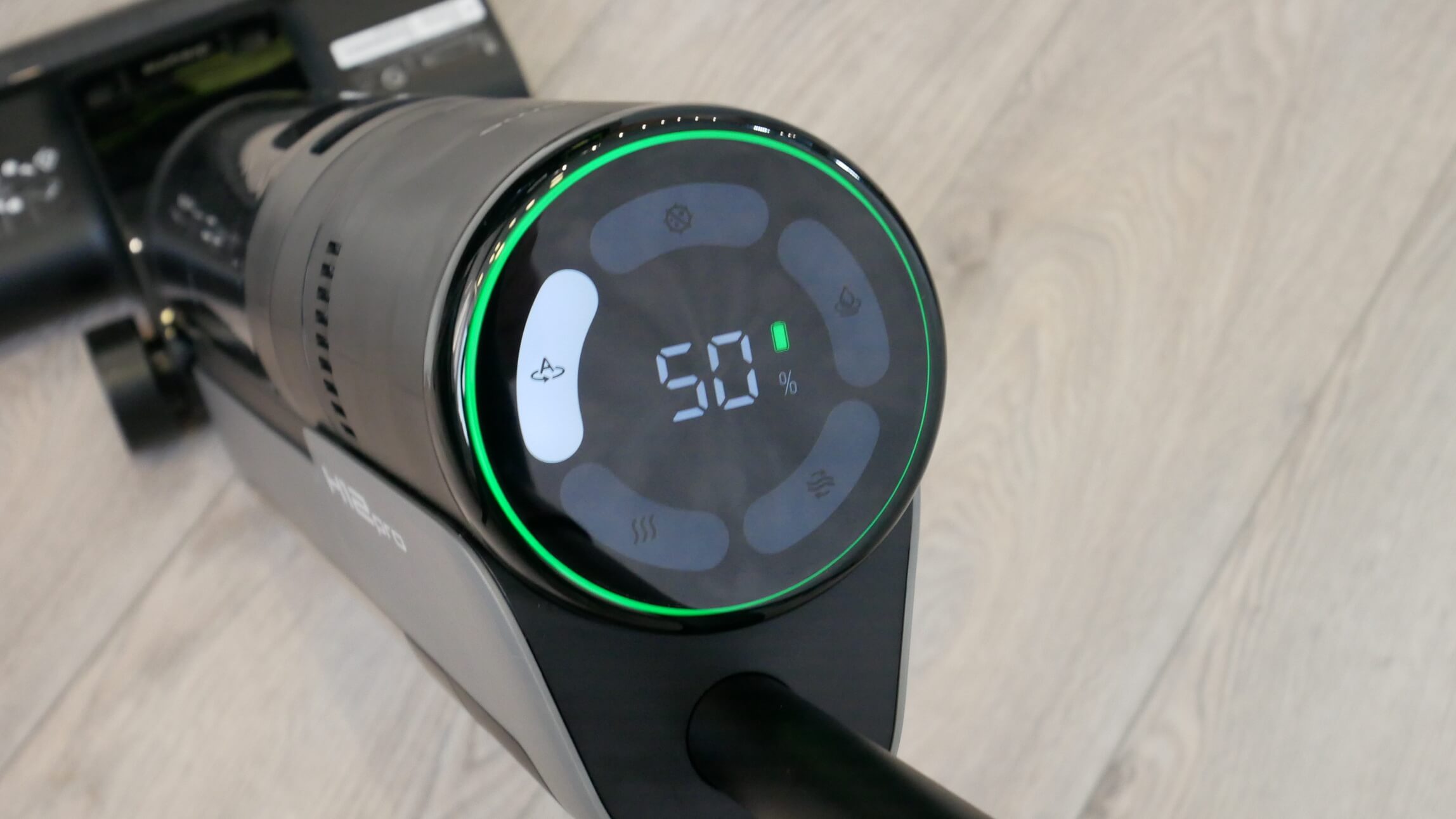
Dreame Display
Both the Dreame and Roborock have all the control buttons located on the handle. These functions will be discussed separately.
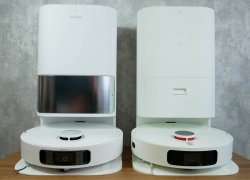
The stations deserve special attention. The Dreame H12 Pro and Roborock Dyad Pro use the station for charging, self-cleaning, and drying the roller. No differences were found in the design, self-cleaning, or drying performance of these rollers during testing.
Ultimately, the Roborock Dyad Pro has the advantage in terms of design. It has a more intelligently designed cleaning module and a coarse filter in the dirty water tank. The Dreame H12 Pro's only advantage is its clean water disinfection feature in the tank. And even then, the effectiveness of this solution could be proven.
Technical specifications
The main characteristics of the compared vacuum cleaners are summarized in a table for easy reference:
| Roborock Dyad Pro | Dreame H12 Pro | |
| Suction power | 17000 Pa | No information |
| Power consumption | 260 W | 300 W |
| Battery | Li-Ion, 4000 mAh | Li-Ion, 4000 mAh |
| Opening hours | Up to 43 min | Up to 35 minutes |
| Clean water tank | 900 ml | 900 ml |
| Dirty water tank | 770 ml | 700 ml |
We see that the Roborock Dyad Pro has slightly longer battery life thanks to its Eco mode. However, the Dreame H12 Pro claims to be slightly more powerful, and I'll be looking into this further during testing.
Functional capabilities
Now about the features. The Roborock Dyad Pro has four operating modes: Eco, Auto, Maximum, and Floor Dry, which uses suction without water. In Auto mode, it can automatically increase suction power when it detects dirt. The vacuum cleaner also features built-in voice alerts, though they're only in English. The device can also be connected to a proprietary app, which lets you customize the self-cleaning mode, drying time, and other settings. You can also use the app to monitor the status of consumables. Overall, it's a handy idea.
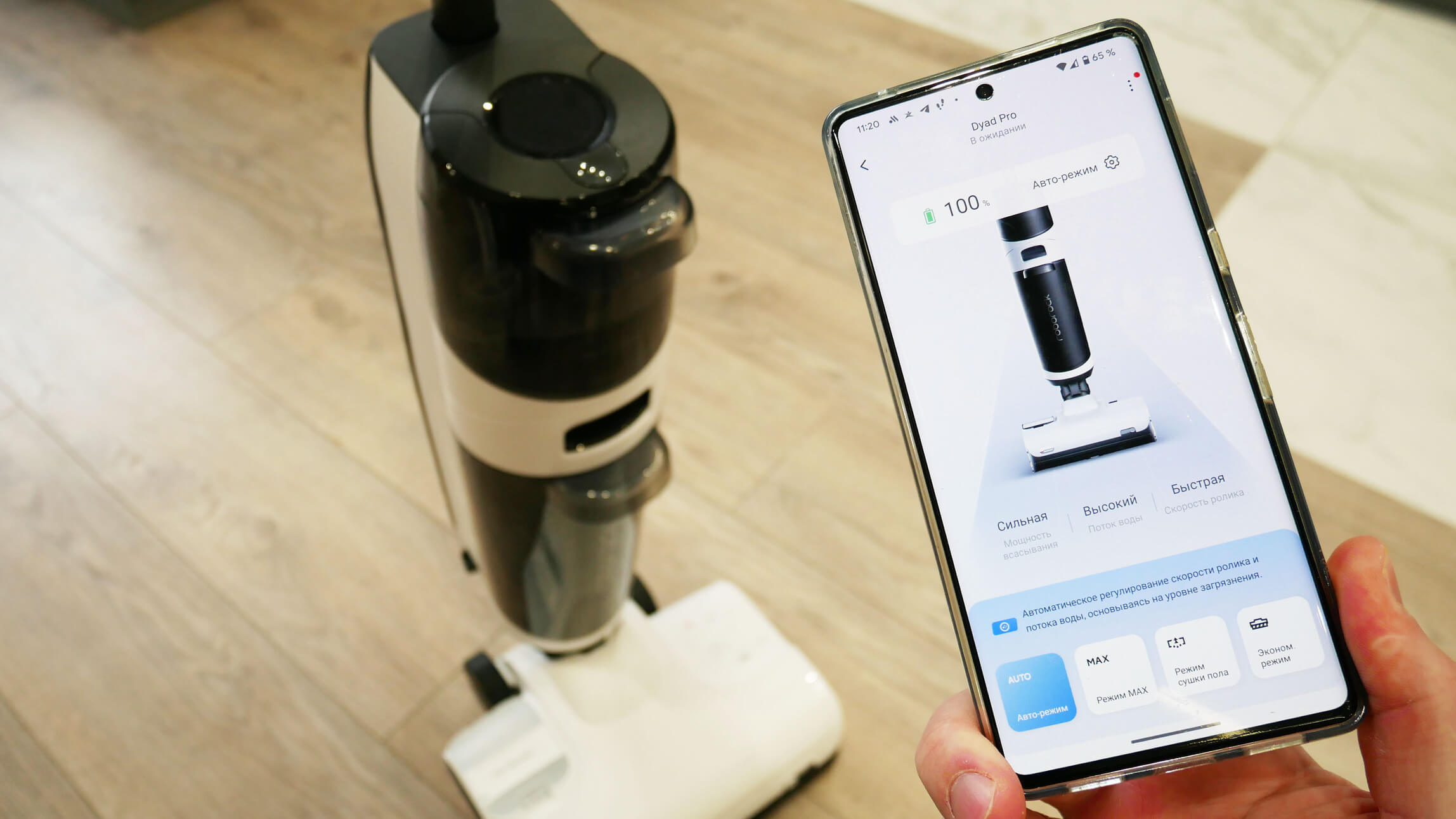
Control via app
The Dreame H12 Pro has five operating modes: automatic, ultra mode, suction mode, self-cleaning, and roller drying. But in reality, it has three operating modes. In automatic mode, the Dreame H12 Pro automatically adjusts suction power based on how dirty the floor is. In ultra mode, water is sterilized before use. Suction mode is used to vacuum liquids from the floor and dry the flooring. Voice notifications are also integrated, but Dreame also offers them in Russian. This is a plus. There is no app connection.
Again, the Roborock Dyad Pro is VERY slightly better in terms of features. But it's not even the app that's the issue, but the presence of a Maximum Power mode. In a separate review of the Dreame H12 Pro, I noted the lack of power control as a drawback, but the Roborock has exactly that: Eco, Auto, and Maximum modes.
Quality of cleaning
And the icing on the cake is a comparison of the Roborock Dyad Pro and Dreame H12 Pro cleaning performance. I recommend watching the video comparison, which shows all the test results:
So, when it comes to dry cleaning, or more precisely, picking up debris on hard surfaces, both vacuum cleaners do an excellent job. They easily pick up debris of various textures from the floor, leaving no blind spots along baseboards and in corners.
I wouldn't recommend using either wet/dry vacuum cleaner for cleaning carpets, even though they're capable of doing so in liquid suction mode. The problem is that the roller type isn't suitable. It gets caught in the pile, and the vacuum cleaner may malfunction. For this purpose, you need a brush with short, coarse bristles, like those found on some other wet/dry upright vacuum cleaners.
Both vacuums performed well in picking up liquids and mixtures, as well as scrubbing away dirt. I didn't notice any difference in efficiency.
But when it came to scrubbing tough stains, the Dreame H12 Pro actually felt more powerful. It completed the task in 4.5 minutes, while the Roborock Dyad Pro took about 5 minutes. Again, the number of stains isn't exactly the same, I understand. Nevertheless, the Dreame feels more powerful, as its stated specifications suggest.
Self-cleaning and roller drying performance are identical. Both compared vacuum cleaners perform well in this regard.
What else?
We've compared the main parameters. But there are a few more I'd like to highlight and which, in my opinion, are worth considering.
The first is noise level. Many people pay attention to this parameter. The Dreame H12 Pro operates quite quietly, with noise levels in the 72-73 dB range. Meanwhile, the Roborock Dyad Pro also starts at 72 dB, but its peak was recorded at 77 dB. It's louder.
Ease of use deserves special mention. Personally, I find Dreame upright vacuum cleaners, including the H12 Pro, much more ergonomic. They literally pull you along while cleaning. The center of gravity is well-distributed, preventing hand fatigue, and the vacuum cleaner's maneuverability is noticeably better. Compared to the Dreame, the Roborock Dyad Pro, as well as its predecessor, are a bit unwieldy and more noticeably heavier, as evidenced by numerous online reviews. While not a deal-breaker, based on my experience with both vacuum cleaners, I can say that the Dreame H12 Pro was much more enjoyable to use during my testing.
And finally, reliability. Of course, both vacuum cleaners are produced by Xiaomi's premium sub-brands, reputable manufacturers with extensive experience in vacuum cleaner production and a wide range of cleaning devices. Furthermore, both Dreame and Roborock are actively sold by official distributors with a full local warranty and service, even in major chain stores, which inspires confidence. However, I personally don't trust the three-roller concept for the simple reason that one is just as effective at scrubbing away dirt in a domestic environment. And the more complex the design, the more expensive and frequent the repairs.
To support my point, I'll share a few comments from my own channel and a popular marketplace:

Bad reviews about Roborock
Yes, this is mostly about the previous model, and perhaps the problem was solved by changing the roller arrangement, or even by upgrading the unreliable components. Or perhaps the negative reviews about the Roborock Dyad Pro simply haven't had time to accumulate because it's a new model and owners haven't been using it for long. But the fact remains that I haven't seen similar reviews about the Dreame. There are some issues, but at least there aren't a ton of complaints about a single component. In any case, both wet/dry vacuum cleaners have received mostly positive reviews online and high customer ratings. It just seems like there are fewer complaints about breakdowns with the Dreame wet/dry vacuum cleaners. It would be interesting to hear from actual owners of these models, including any repair experience and what exactly broke.
Personal opinion
After comparing the main parameters individually, I've compiled a table of the key ones to consolidate the results and help you easily understand how the Roborock Dyad Pro differs from the Dreame H12 Pro.
| Roborock Dyad Pro | Dreame H12 Pro | |
| Cleaning module | Three rollers extend completely to the edges of the body on both sides | One roller for the entire width of the cleaning module (blind zone up to 8 mm on each side) |
| Automatic detergent supply | Yes | No |
| Water disinfection | No | Yes |
| Tank capacity | 900+770 ml | 900+700 ml |
| Coarse filter | Yes | No |
| Operating modes | Eco, Auto, Maximum, Suction without water supply | Auto, Ultra (disinfection), Suction without water supply |
| Automatic power increase when contamination is detected | Yes | Yes |
| Drying the roller with hot air | Yes | Yes |
| Setting up parameters in the application | Yes | No |
| Voice notifications in Russian | No | Yes |
| Power consumption | 260 W | 300 W |
| Opening hours | Up to 43 min | Up to 35 minutes |
| Noise level | 72-77 dB | 72-73 dB |
| Dry cleaning quality | High | High |
| Quality of carpet cleaning | Low/medium | Low/medium |
| Floor cleaning quality | High | High |
| Self-cleaning quality | High | High |
| Roller drying efficiency | High | High |
| Ease of use | Less convenient | Very convenient |
| Reliability | Questionable reliability of the cleaning module | No serious comments |
To sum it up, I'll answer the main question right away. Of the two wet/dry vacuum cleaners being compared, the Roborock Dyad Pro is objectively the superior one. It wins in design, functionality, and even price. In any case, the main feature that still allows it to confidently hold its own among the leaders is the rollers extending to the edges on both sides. No other wet/dry vacuum cleaner has rollers that close to the edges, and this is definitely a strong point compared to its competitors.
Still, the Dreame has its advantages over its competitor. It's slightly more powerful, quieter, more ergonomic, and, most importantly, more reliable, in my opinion. If these factors are more important to you, then sacrificing the narrow, non-washable area along the baseboard makes sense.
And, of course, you need to consider the price. If the price difference is significant, it makes sense to choose the cheaper one.
On that note, I'd like to conclude this comparison. If you have any questions, please ask them in the comments. Happy shopping, everyone. Bye!