Dreame Bot L10s Ultra vs. Xiaomi Mijia Omni B101CN: What's the Difference and Which One to Choose?
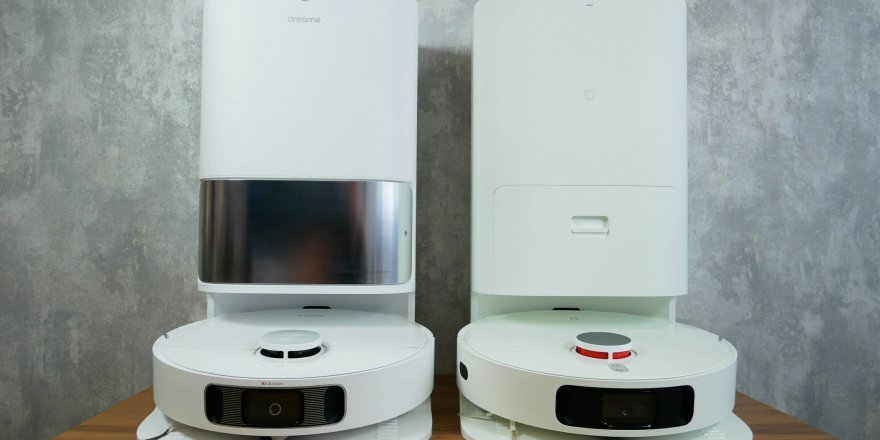
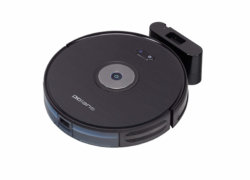
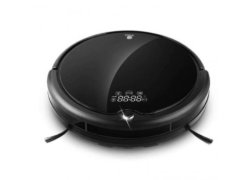
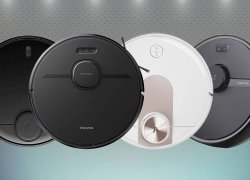
In this post, I'd like to compare two rather interesting robot vacuum cleaners that are visually virtually identical, yet one costs nearly $1,400, while the other is half the price—around $700 at the time of writing. We'll be talking about Dreame Bot L10s Ultra, who headed Overall rating of tested robotic vacuum cleaners in 2022 and Xiaomi Mijia Omni B101CN, which took third place. Many are wondering what the real difference is between these two top-tier products and, most importantly, whether it's worth paying twice as much or just not worth it. I'll cover everything in detail below, comparing design, functionality, cleaning performance, and other parameters. So, let's get started!
Appearance and design
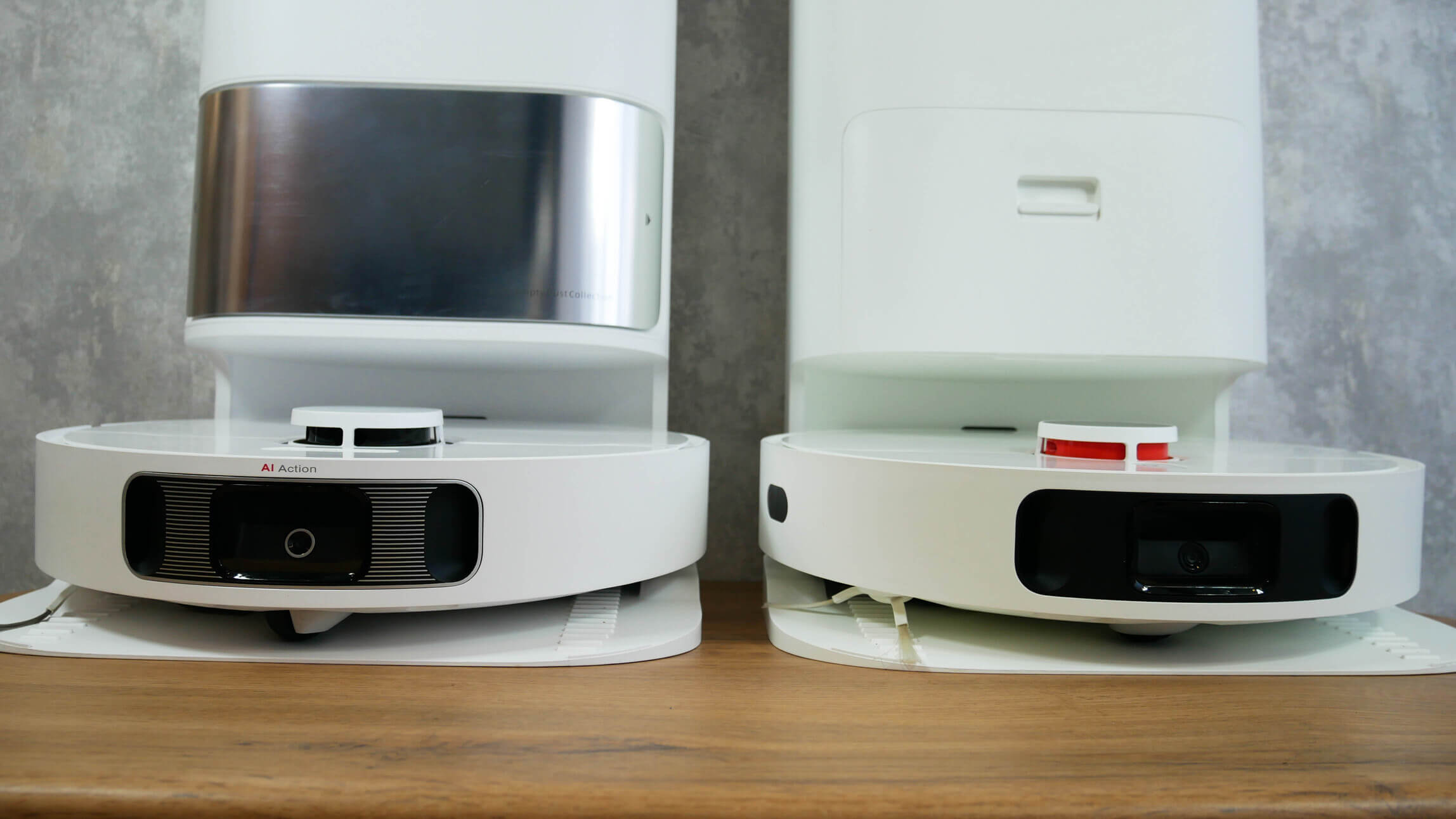
Let's start with the robots' appearance and design. When you see a Xiaomi robot vacuum cleaner—specifically, a Mijia robot vacuum—compared to other Chinese robots, it seems like it's made of very high-quality materials. The plastic is pleasant to the touch, and all the components are neatly assembled, leading many to claim that Mijia robots are in no way inferior to their Dreame or Roborock counterparts, which are also part of the Xiaomi ecosystem. But no, folks, that's not true. And here's proof of my words:
Color comparison
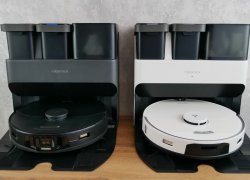
If you compare the two robot vacuums side by side, you'll see that the Mijia flagship looks significantly cheaper and less expensive. The yellowish plastic gives it precisely this cheap feel, compared to the Dreame's crisp white plastic. So, despite what anyone says, despite its identical design and build, the Mijia is inferior to the Dreame. And this isn't just due to the plastic, but also, in some cases, the internal components, though not always.
Another thing that was noticed by attentive subscribers in the Mijia Omni B101CN review was that the plastic on the back was slightly bulging. And this is the condition out of the box. This isn't unique. Commenters note that some owners received their robot in the same condition. I easily fixed this manufacturing defect with a flathead screwdriver, pushing the plastic back into its grooves, but in any case, it's not ideal. I haven't encountered similar reviews with the Dreame, and this again reflects the difference in build quality, which is why we pay extra.
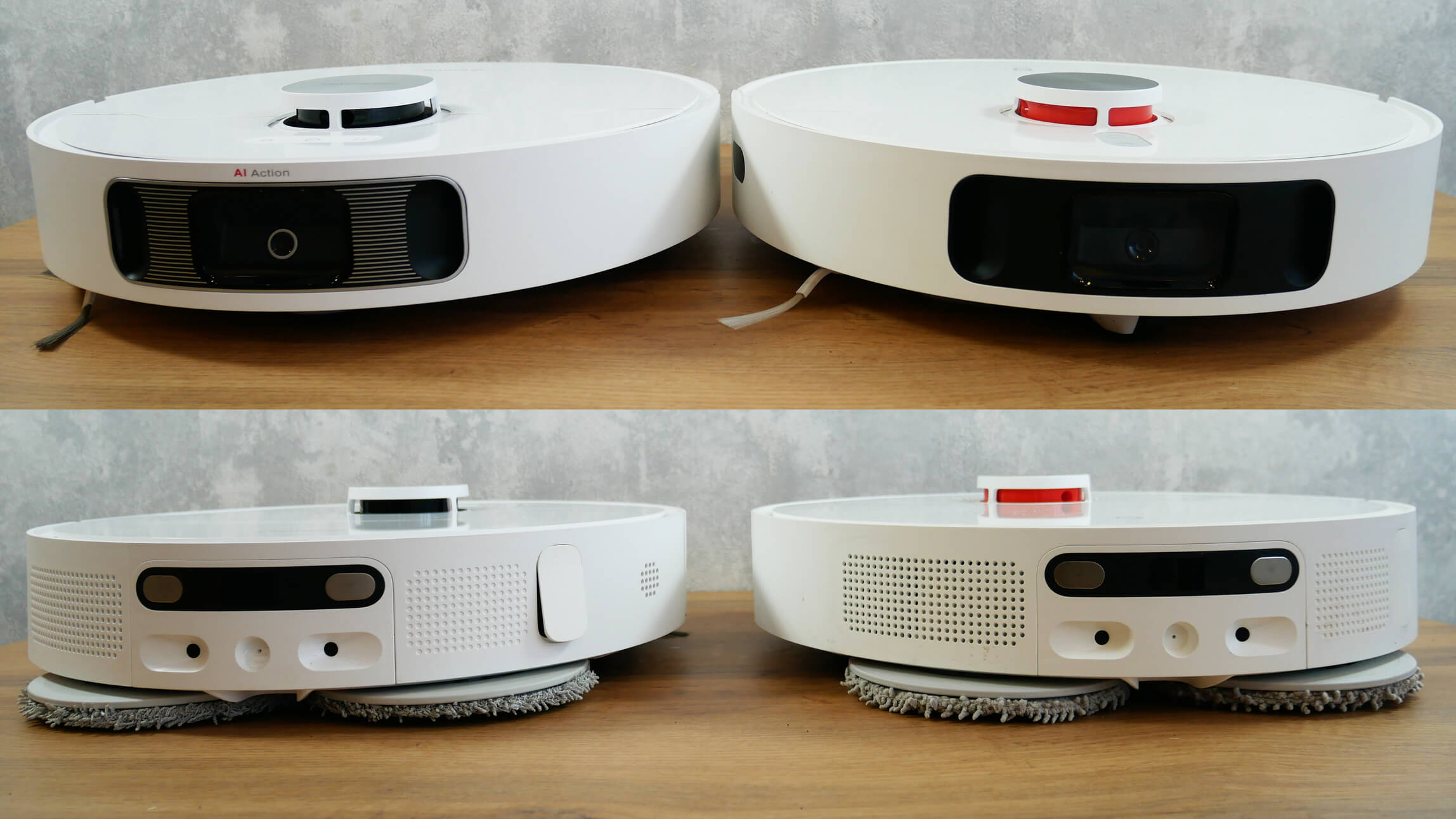
Now, let's talk about the robots themselves and the design differences between them. The robot vacuums themselves are virtually identical. The design differences are minimal, namely:
- The Dreame has three mechanical control buttons on the body, while the Xiaomi has two. This isn't a significant difference.
- The Dreame has a silicone turbo brush, while the Xiaomi has a standard bristle-and-petal brush. The silicone brush is much easier to clean from tangled hair and pet hair.
- And, most importantly, the Dreame has an active camera installed on the front bumper for object recognition on the floor and remote home monitoring via smartphone. Xiaomi has a system of sensors that only identify objects on the floor, but they don't recognize them, and there's no way to connect to the camera remotely. This isn't just a hardware issue, but also a software one. It's possible their cameras are even identical in design.
Design comparison
I couldn't find any other differences between the robots. The only thing I'd like to add is that the central brushes are the same size on both robots, making them interchangeable. However, with the Xiaomi, if you want to install a silicone brush, you'll need to buy an additional frame, as the stock one tends to squeeze the brush.
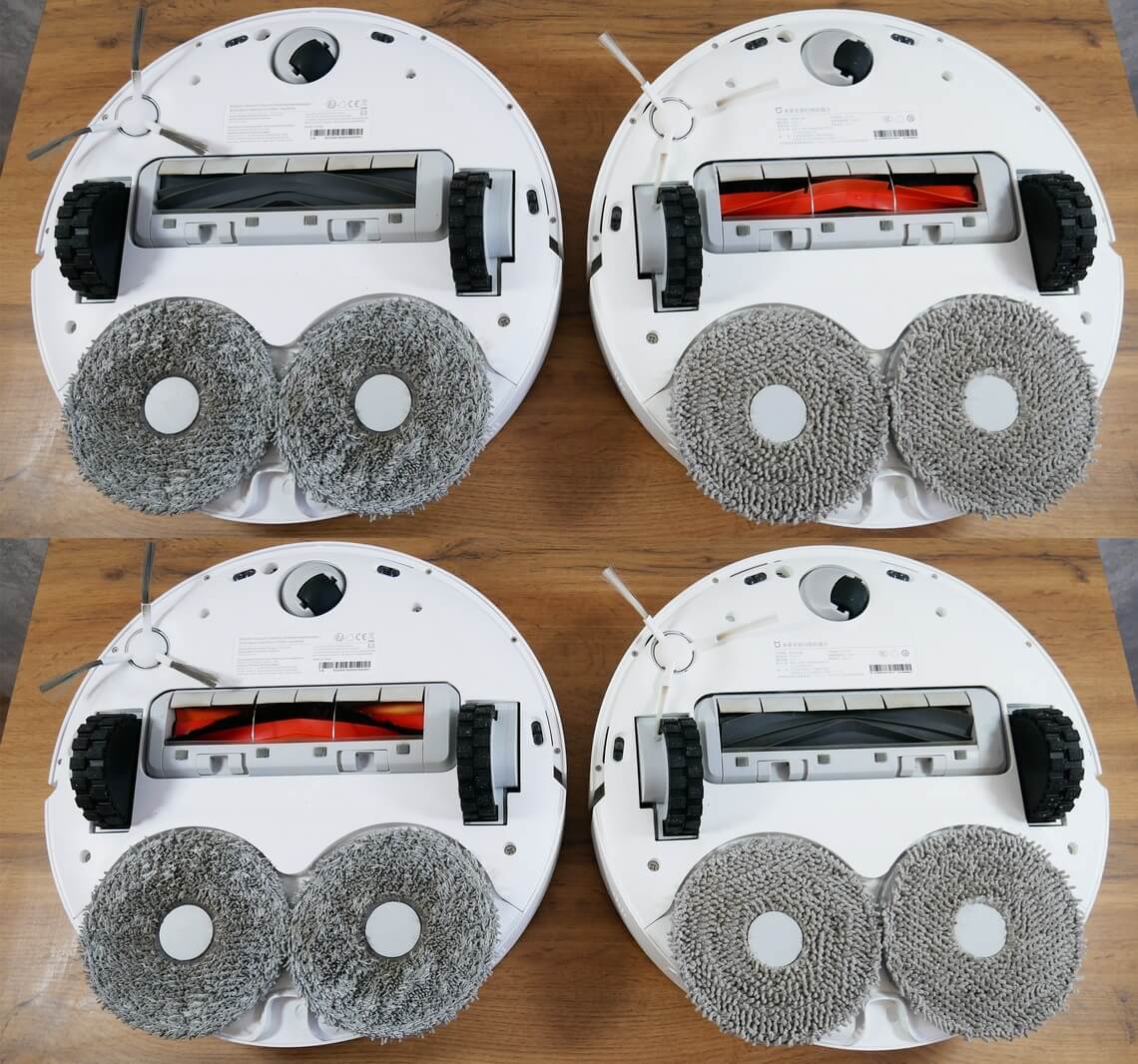
Comparison of the cleaning module (replacement of turbo brushes)
The stations are also slightly different. The platforms for robot entry and rinsing wipes are identical. Dreame changed the color of the cover that conceals the dust bag during self-cleaning. Moreover, Dreame's cover attaches more conveniently with magnets and is equipped with a holder for storing the robot's cleaning tool. Mijia's cover matches the station's color and is secured with mechanical fasteners.
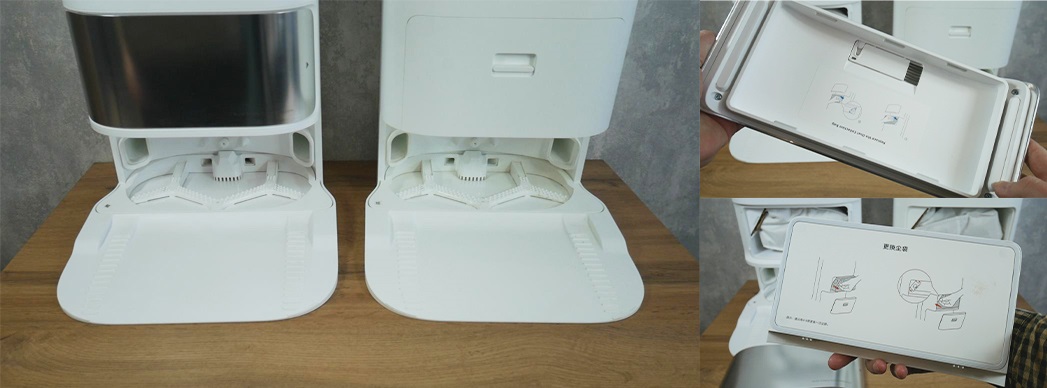
Comparison of stations (covers)
A more significant difference between the stations is revealed by looking under the top cover. The robots' clean and dirty water tanks are identical in design and capacity. However, the Dreame Bot L10s Ultra features a detergent cartridge installed underneath the tanks, which is automatically added when the wipes are rinsed. This is a truly innovative solution that improves the quality of wet cleaning. The Mijia B101CN lacks this feature, but a new one has already appeared on the market. Mijia OMNI 1S, which has just such a module in its station and can also be connected to water and sewer systems, something comparable robots can't do. Just for information.
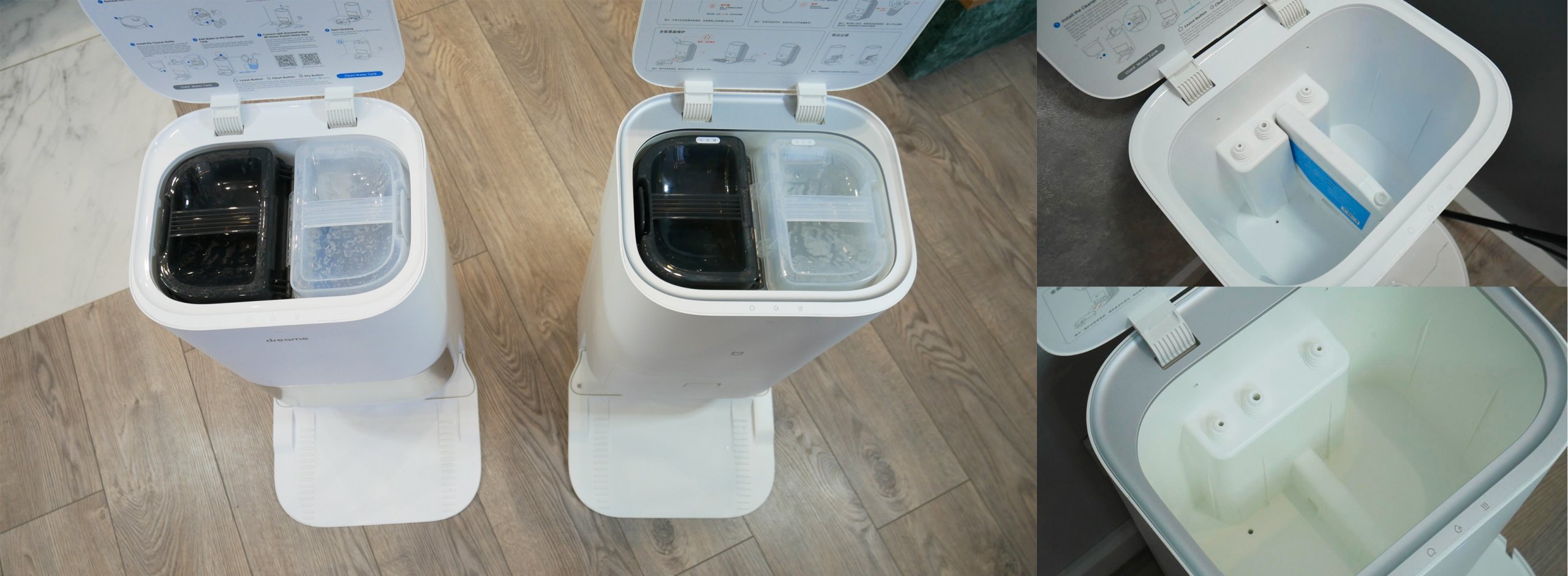
Comparison of stations (reservoirs)
So, in the end, we see that Dreame still wins in terms of design and build quality, but I don't think it's worth paying twice as much for. Let's see how else the robots differ.
Technical specifications
In terms of specifications, the suction power differs, which will be further verified in real-world tests. And for some reason, despite the visual similarity, the Dreame advertises a larger dust bag for the station. In my opinion, this is extremely insignificant, even if true. Otherwise, the robots are identical in specifications.
| Mijia OMNI B101CN | Dreame Bot L10s Ultra | |
| Battery | Li-Ion, 5200 mAh | Li-Ion, 5200 mAh |
| Suction power | up to 4000 Pa | up to 5300 Pa |
| Cleaning area | up to 200 sq.m. | up to 200 sq.m. |
| Dust collector | 350 ml | 350 ml |
| Water tank | 80 ml | 80 ml |
| Passability | up to 20 mm | up to 20 mm |
| Dimensions | 350*97 mm | 350*97 mm |
| Station capacity | 1000 W | 1000 W |
| Clean water tank | 2.5 l | 2.5 l |
| Dirty water tank | 2.5 l | 2.5 l |
| Bag in the station | 2.5 l | 3 l |
| Dimensions | 423*340*568 mm | 423*340*568 mm |
Controls and functions
As for features, there are a few differences. First, the Mijia OMNI B101CN is a robot vacuum cleaner designed for the Chinese market. Consequently, it's controlled via the China region in Mi Home and runs on Chinese servers. Surprisingly, the app didn't freeze during testing, and the interface is in Russian. The only hint of its Chinese roots is that the robot speaks Chinese, but that's not a big deal. You can install Mi Home by vevs, for example, and add a cool, Russian, gopnik-style voiceover if needed.
The Dreame Bot L10s Ultra is a global version of the robot vacuum cleaner, available right out of the box, with a Russian interface, instructions, and voice notifications. Furthermore, it can be controlled not only via Mi Home in Russia but also via the proprietary Dreamehome app, which works more reliably and is updated more frequently to fix bugs. For me, this is a small, but still a plus.
The robots have almost identical functionality, but there are still some differences, namely:
| Mijia OMNI B101CN | Dreame Bot L10s Ultra | |
| Self-cleaning | + | + |
| Rinsing napkins at the station | + | + |
| Drying napkins with hot air | + | + |
| Adding detergent | — | + |
| Lifting napkins on the carpet | + | + |
| Identifying objects on the floor | + | + (recognition) |
| Remote home monitoring | — | + |
| Saving multiple cleaning maps | + | + |
| 3D map of the room | + | + |
| Zoning the premises into rooms | + | + |
| Selecting areas and rooms for cleaning | + | + |
| Virtual walls and no-go zones | + | + |
| Suction power adjustment | + | + |
| Setting the rinse frequency | + | + |
| User mode | + | + |
| Cleaning log | + | + |
| Setting up a cleaning schedule | + | + |
| Voice notifications in Russian | + (additional settings required) | + |
| Increased power on carpet | + | + |
| Carpet round | + | + |
As mentioned in the design overview, the Dreame Bot L10s Ultra can automatically add detergent when rinsing cloths. It recognizes objects rather than simply identifies them. Voice alerts in Russian are available from the box. And, most interestingly, the robot's camera can be connected remotely from a smartphone to monitor your home. Personally, this is a very useful feature that expands the robot's capabilities. For example, you can check on the condition of your home while on vacation, if necessary. Or, even more simply, you can check whether you've unplugged the iron by driving the robot to the outlet and transmitting the image to your smartphone screen. Clearly, this isn't the most important feature when it comes to a robot vacuum cleaner, but it could nevertheless be useful for many.
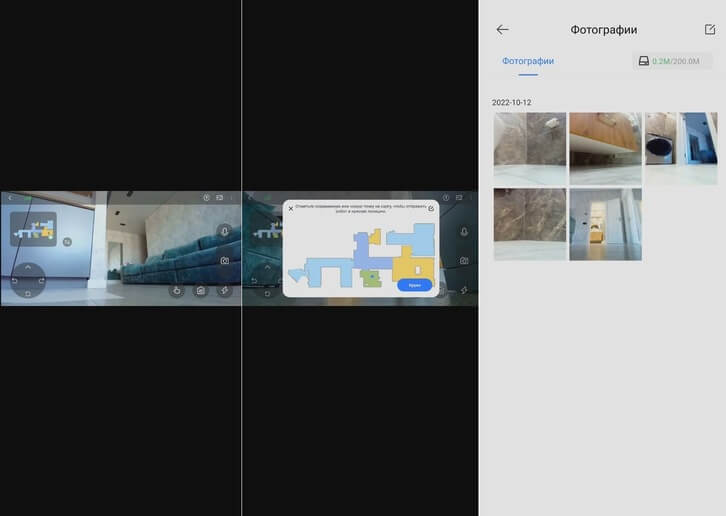
Remote home monitoring
And it's these software capabilities that are the reason for the extra cost. This is likely the main reason for such a significant price difference. For comparison, the same Roborock adds $100 or more to the price of a camera, and when comparing flagship S7 Pro Ultra and S7 MaxV UltraThe price difference is $200-$250, roughly speaking, just for the camera.
Quality of cleaning
And finally, what's important to compare is cleaning performance. Under identical conditions, the robot vacuums were tested on different surfaces and test benches. I'll go over each test result in turn.
The robots' dust collection performance on hard surfaces is identical. They thoroughly pick up debris from the floor, leaving only a small amount of uncollected space in corners due to the round shape of the body. However, as noted earlier, the silicone turbo brush is much easier to clean from tangled hair and fur than a conventional bristle-petal turbo brush.
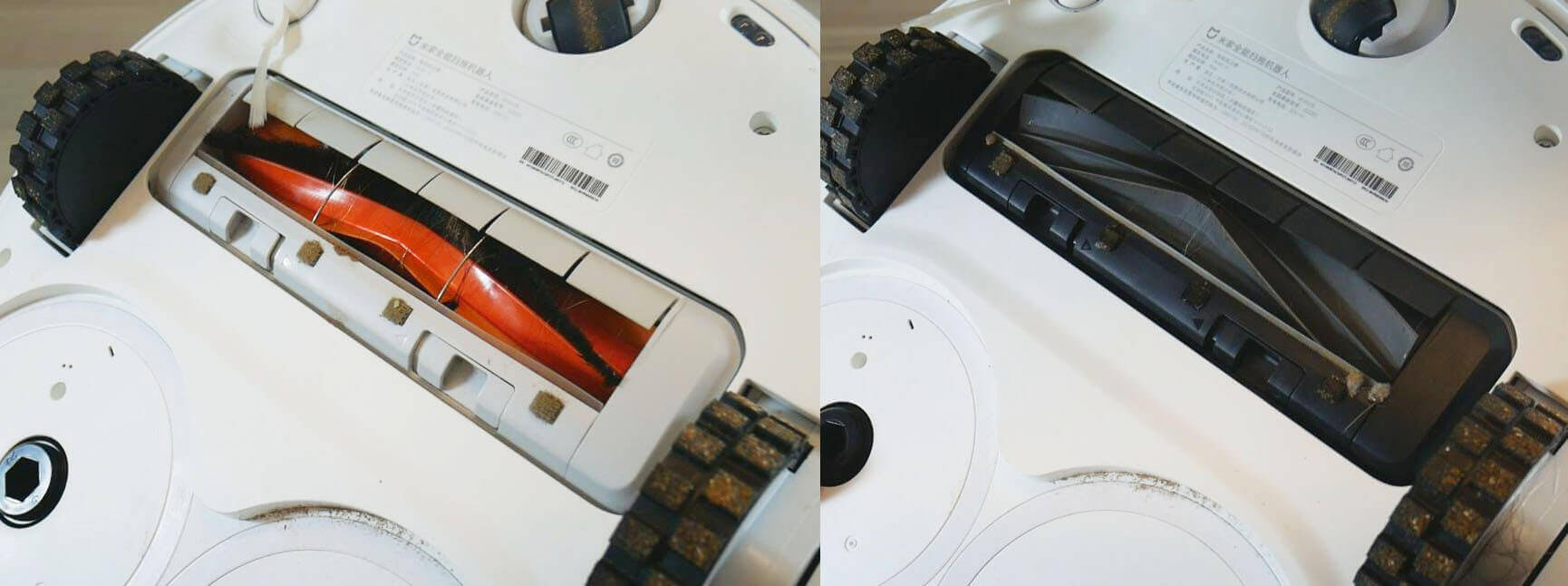
Comparison of brushes
However, silicone brushes have a drawback, which is why they haven't been widely integrated into robot vacuums. On carpets, these brushes are slightly less effective at picking up debris, as noted in tests. In the Dreame case, carpet cleaning performance was generally high, but a few hairballs were still left behind. The Mijia OMNI, with its standard brush, cleaned the carpet slightly better.
And here's what was the biggest surprise for me: despite its higher claimed suction power, the Dreame Bot L10s Ultra barely removed debris from a 4 mm gap, while the Mijia OMNI was able to vacuum even from a 10 mm gap. The Mijia OMNI B101CN proved to be significantly more powerful than its Dreame counterpart, and perhaps this factor contributed to its superior carpet cleaning. In any case, 4 mm is a good result, but the robot vacuum cleaner is still not as powerful as its budget counterpart.
Increased power also results in higher noise levels. The Xiaomi Mijia OMNI robot vacuum cleaner is quite noisy at maximum power, reaching 73 dB, while the Dreame's Turbo mode measured only 66.5 dB. So, consider carefully whether you need super-power if you plan to run the robot vacuum while you're at home. You won't be able to comfortably watch TV with such a noise level. However, if you run the robot vacuum after work or while walking, as many do, the noise level will be completely unimportant to you, as it was to me.
The other parameters, such as wet cleaning performance, maneuverability, self-cleaning performance, and wipe rinsing, are identical for both robots. You can check out detailed reviews of each robot to learn more about their test results. I can only highlight one important observation for many: both robots are resistant to black floors, which is a plus.
Dreame Bot L10s Ultra video review:
Video review of the Mijia OMNI B101CN:
Oh, and speaking of the object recognition system, both the Mijia OMNI B101CN and the Dreame Bot L10s Ultra are blind in complete darkness. However, in good lighting, the Dreame camera recognizes objects on the floor and displays them as corresponding icons on the map.
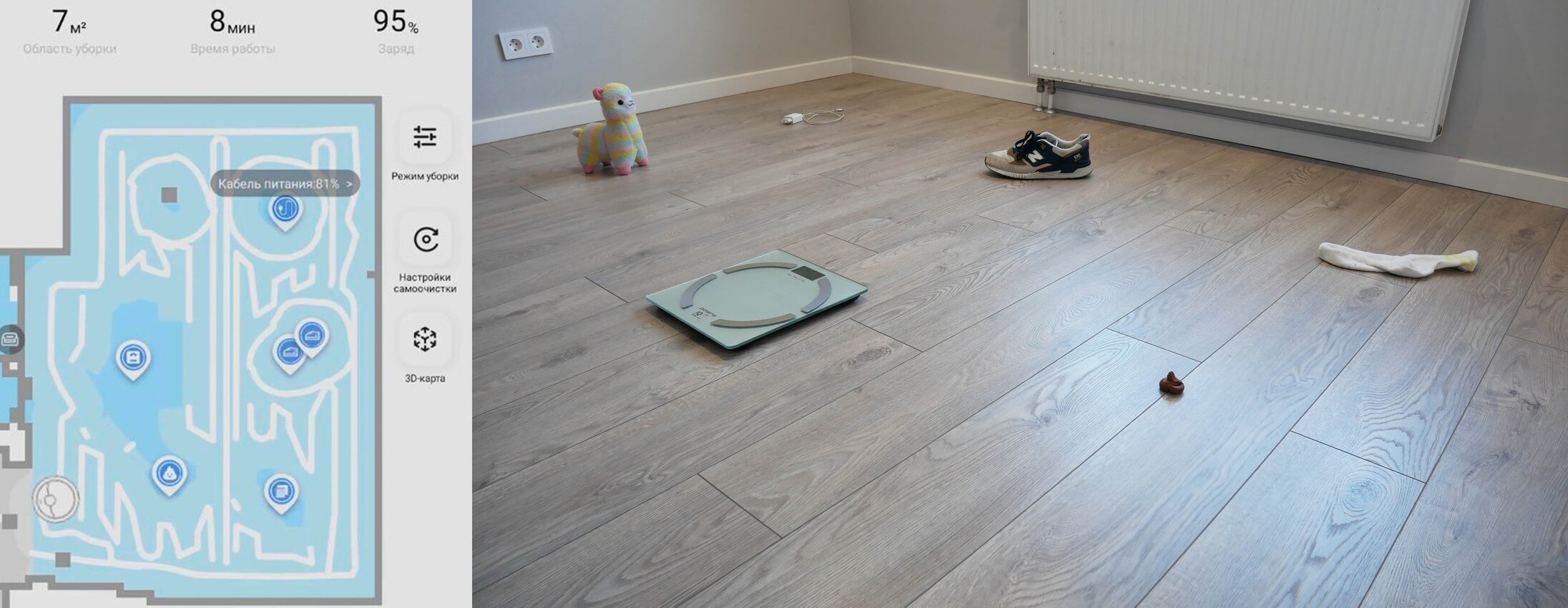
Recognizing objects on the floor (Dreame)
Mijia OMNI is not capable of this, although it also carefully navigates around obstacles in its path.
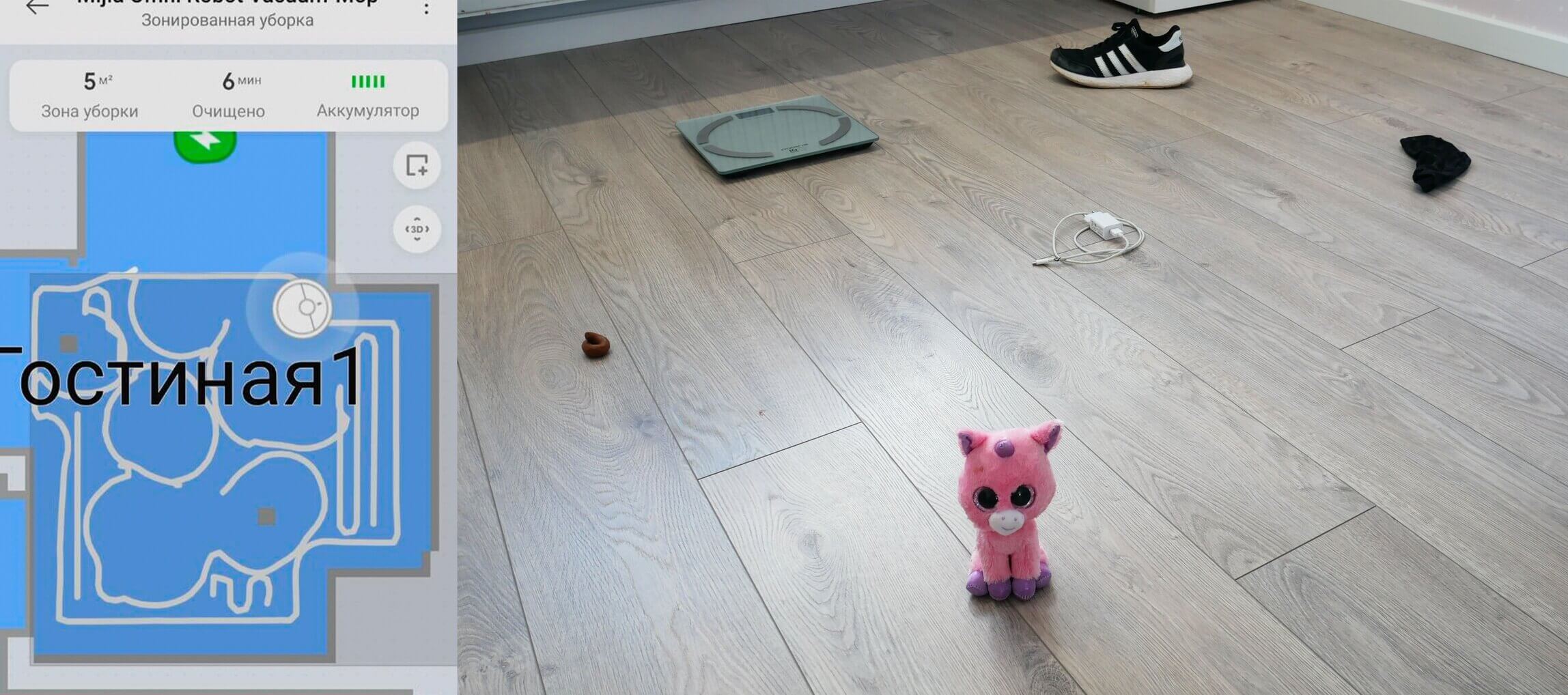
Recognizing objects on the floor (Mijia)
I can say with a high degree of certainty that Dreame is less likely to chew on a sock, a charger cord, or to surprise a pet that is not litter-trained.
Personal opinion
I've thoroughly compared the Dreame Bot L10s Ultra and Xiaomi Mijia Omni B101CN robot vacuums. Finally, I'll share my opinion on which robot vacuum is better. You've undoubtedly seen for yourself that the Dreame is better built, has a more accurate object detection system, can automatically dispense detergent when rinsing the wipes, can stream camera footage to your smartphone, and, just as importantly, works well with its app. Its brush is also easier to remove hair and pet hair, especially for those who care about pet hair. But is it worth the extra cost when the Mijia OMNI B101CN offers nearly identical functionality and cleaning module, and is even significantly more powerful and slightly better at cleaning carpets?
In my opinion, the price of Dreame is indeed a bit high, but this does not diminish its key advantages, thanks to which The Dreame Bot L10s Ultra is objectively BETTERBut if the above-mentioned advantages, and most importantly the object recognition system, aren't your top priority, then I don't think it's worth paying double the price. You can upgrade your Mijia OMNI with an additional cover and brush, and get a robot vacuum cleaner with the same cleaning performance, only more powerful. And with the 1S, you'll even get a detergent cartridge.
Therefore, my conclusion is that the Mijia OMNI B101CN robot vacuum cleaner is more optimal in terms of price and quality, which is why I named it the people's leader in 2022.
Mijia OMNI B101CN:
But if you're looking for the best robot vacuum cleaner in 2022, it's definitely the Dreame Bot L10s Ultra. The differences between them aren't huge, sometimes even minor, but they're still there.
Dreame Bot L10s Ultra:
There's also the issue of brand support, as the Chinese Mijia robot vacuum cleaners haven't fared well in this regard. Even now, the OMNI B101CN is mostly sold on AliExpress, despite being on sale for a long time. Meanwhile, Dreame has official distributors on the market who provide full support, and I hope they'll start selling their flagship model soon.
On this note, I'd like to conclude our comparison of the Dreame Bot L10s Ultra and the Xiaomi Mijia Omni B101CN. If you have any questions, please ask them in the comments. Happy shopping, everyone. Bye!